By Ode Siivonen
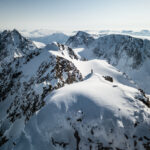
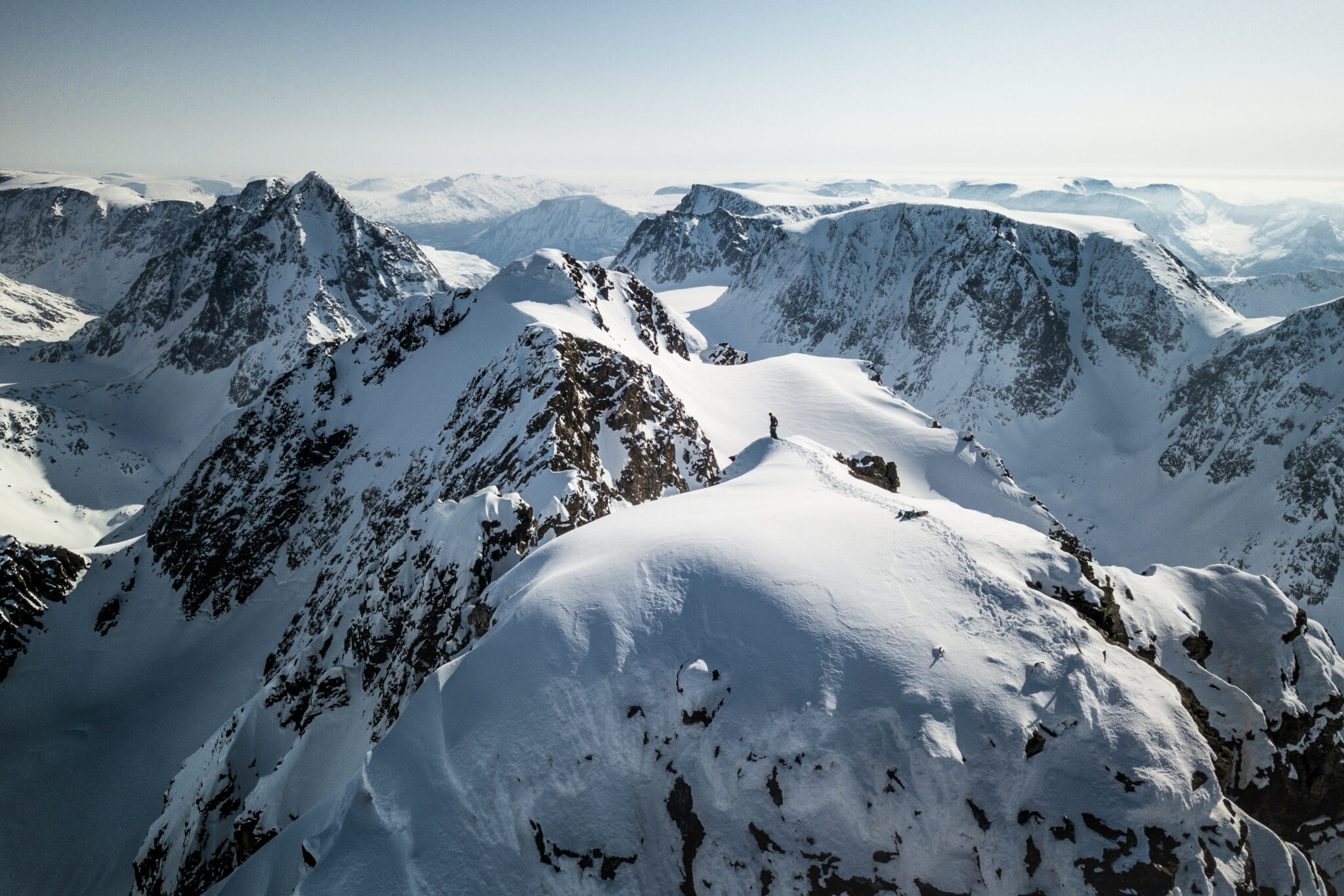
Lyngen Alps is a mountainous peninsula at 69° North, in Northern Norway. The beauty of Northern Norway is that there is an endless number of mountains from Lofoten to Finnmark and towards inland and the Lyngen peninsula is in the heart of it. The peninsula is narrow, only about 20 kilometres wide but reaching almost 90 kilometres out to the North Atlantic Ocean. The whole area from tip to toe is filled with steep pointy peaks, huge, glaciated mountain massifs and beautiful valleys, all surrounded by deep fjords on both sides and the open ocean towards the North. The region has 124 summits over 1000 meters, the highest peak being 1834 meters rising from sea level, making it one of the Northern Europe’s most pronounced big mountain areas.
Skiing has always been a part of the Norwegian culture but in the beginning, Lyngen was an alpine climbing destination. Alpine climbing in the area, at least the recorded part of it, started sometime around 1880 and many of the highest peaks got climbed by the pioneers from Norway, England, Switzerland and Germany. Over the next century, most of the summits were climbed via numerous different routes but the skiers remained at the bottom of the valleys. People have for certain been skiing in the area since the skis have been invented but there is very little information about the early descents. One notable first descent, Tomas Couloir, a beautiful 1350-meter line and an area classic on the West face of Store Lakselvtind, fell under the belt of a Swede, Åke Hedlund in 1970. In the nineties, the local strongman Oystein Stangeland skied numerous steep lines in his low leather boots and telemark skis.
“When I first arrived to Lyngen in 1998 with two other Finns, Jarkko Henttonen and Ape Majava, my trusted partners in the mountains, we basically had a virgin and untouched area what came to steep skiing. We had already spent 7 winters in Chamonix and La Grave, learned a little bit about the mountains and a lot about the steep skiing history in the Alps so we were motivated to explore and go after the big, steep lines in Lyngen. The Norwegian tradition “toptur” meaning a summit trip, usually via the easiest route, was what most of the people were doing with skis on. At the time there were very few people who were exploring steeper couloirs and exposed lines so we could pick and choose the cherries from the cake and over the next fifteen years we did well over 50 first descents in the area before more people started showing up. It was an orgy. Steep, unridden lines everywhere you looked, huge amounts of snow, no people, no guidebooks, no mobile phones, no internet. Being young, motivated and not too afraid to commit, we had some good adventures, and we got stuff done. It was our private paradise. During the days we skied and snowboarded everything we could get our hands on and during the evenings we studied the paper maps and a few photo books of the area looking for features showing possible new lines. During rare rest days we were driving around and looking for more lines.”
In recent years of course more people started recognising the area’s potential and more lines started appearing in the map. A visionary Swedish skier, Linus Johansson opened a few dozen of beautiful lines, most of which have become true classics. Seth Morrison, Remy Lecluse and Andreas Fransson among others left their mark opening new lines and pushing the Arctic big mountain skiing forward. Nowadays the steep skiing torch in the area is in good hands of the young, strong locals like Krister Kopala, Eivind Aanesen and Nikolai Schirmer, who are putting in new committing and technical descents every season and skiing them with the best possible style, all in, flat out, from top to bottom.
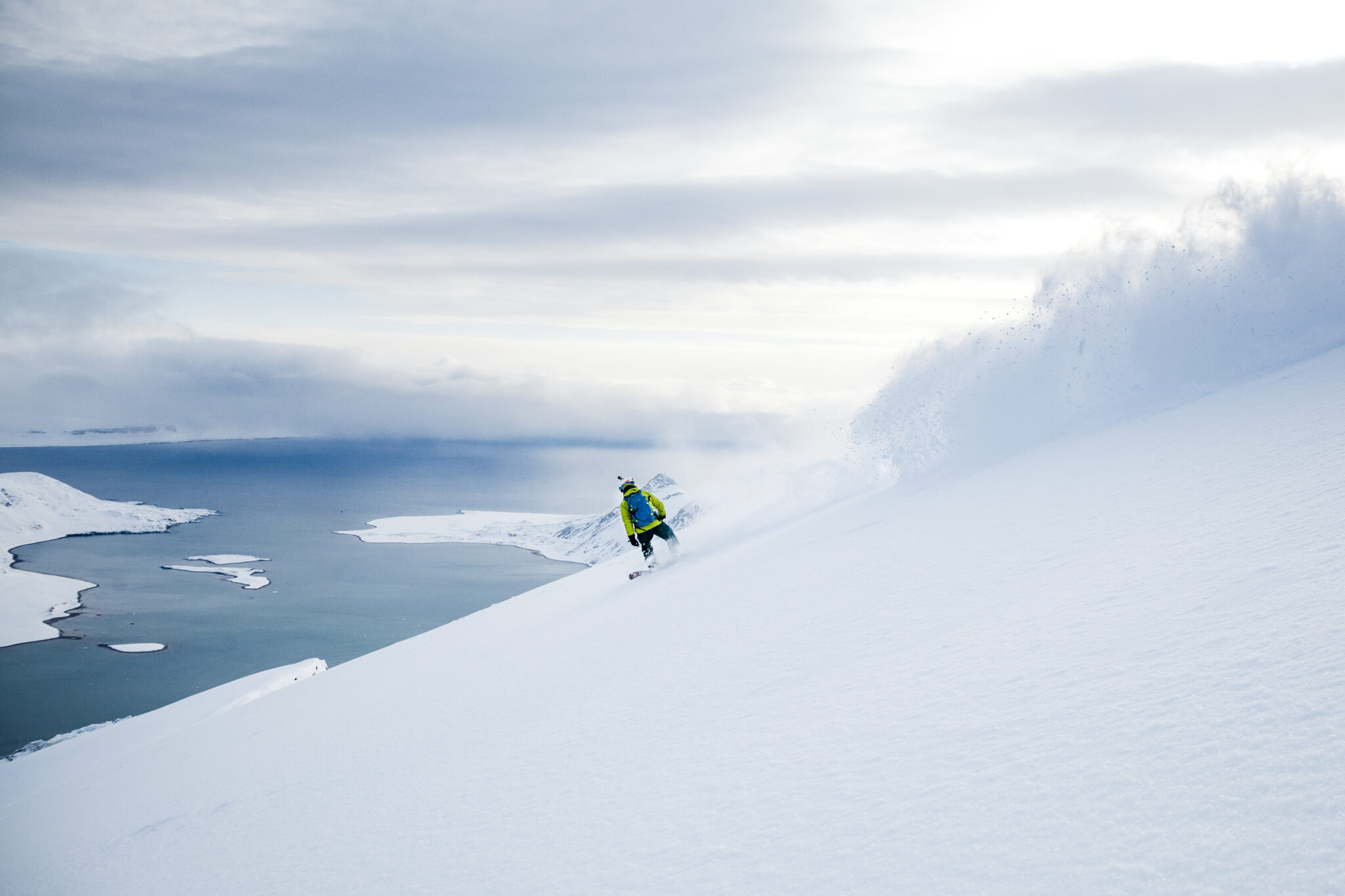
There is no lift access skiing nor are heliskiing or other motorised means of transport allowed. It is virtually a human powered skitouring and steep skiing paradise. The mountains rise from the North Atlantic Ocean, offering some of the best skiing on the planet. There is something for everyone, from mellow low angle cruising on non-glaciated or non-avalanche terrain, to big steep couloirs and complex exposed mountain faces. On the west side of the peninsula, it is possible to ski a continuous vertical drop of 1700 meters from summit to the sea on a 30-45° slope or ski a run of 1000 meters in a 45° couloir.
Lyngen Peninsula itself has started to show up big time on the world ski map and every year there’s more and more international groups coming to get their share of Arctic skiing. Most of the groups usually stay in the northern part of the peninsula in the fishing village of Nordlenangen where the views to the fjords and the ocean are phenomenal and the mountains are generally a little bit lower angle. Lyngseidet on the east side is the biggest village in the area with more accommodation options and shops and is also a popular destination with plenty of great skiing. The skiing in those areas can sometimes get crowded on the most popular summits but there are plenty of options for an imaginative skier to put in fresh tracks. There are also plenty of other options in the nearby areas if the mountains get crowded. Tamokdalen, a valley just south of Lyngen with endless potential, is only a short drive away and often has colder temperatures and a climate more towards continental than maritime.
“While Nallangaisi is probably the prettiest mountain in Lyngen, at least in my mind, my favourite area is in the southwestern corner of the peninsula, around the village of Lakselvbukt. The mountains there are steep and pointy and filled with interesting terrain. Big couloirs and exposed faces, spine lines and good trees. Especially Lakselvtindan massif, 1616 meters above sea level, which consists of ten independent summits and three glaciers with possibilities to ski to every aspect via over 30 different lines, most of which are quite big and serious. It’s a fantastic spot for big mountain skiing and by far my favourite playground in the area.”
Unlike Alaska, BC or New Zealand where one often needs some sort of motorised transport to access the mountains, in Lyngen the access to the foot of the mountains is relatively easy with good road network. It is often possible to park underneath the chosen objective and start skinning uphill right below the line. See it and ski it is a good way to do it. Of course, there’s sometimes longer approaches when wandering deeper into the mountains but the approach is rarely longer than a couple of hours. Most of the lines in Lyngen are possible to do in a day for fit and competent team. The roads also make it easier to follow the conditions and weather. Good road access makes it easier to drive to a different area to find the blue holes in the sky and get the best out of the day. Although Norway is considered as an expensive country in general, skiing up there is fairly cost effective. Reasonably priced plane tickets to Tromso are available from any big European hub, a rental car and a local accommodation split between a group of skiers will not cost an arm, at least in comparison to a heliski trip or an overpriced ski resort.
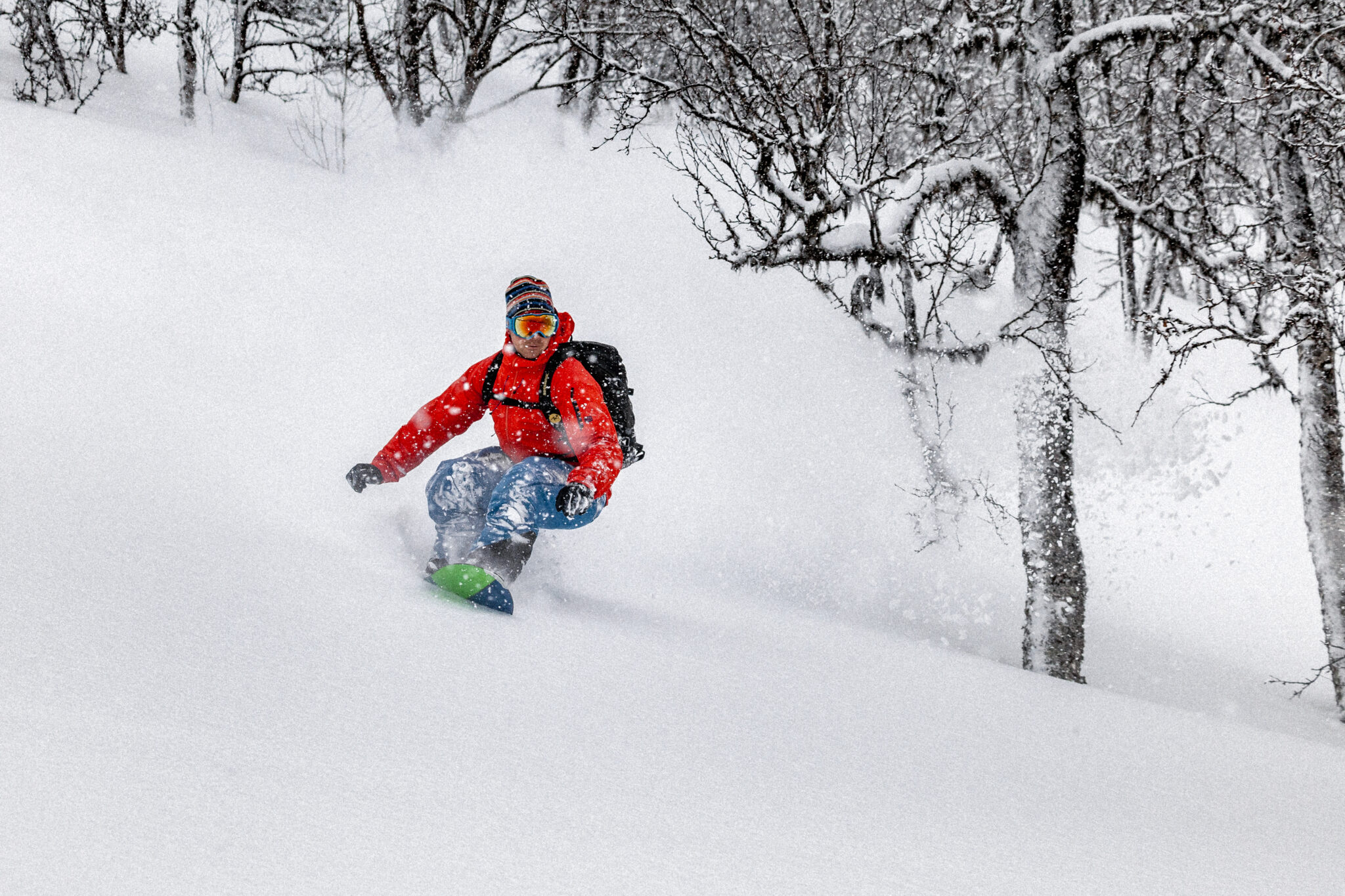
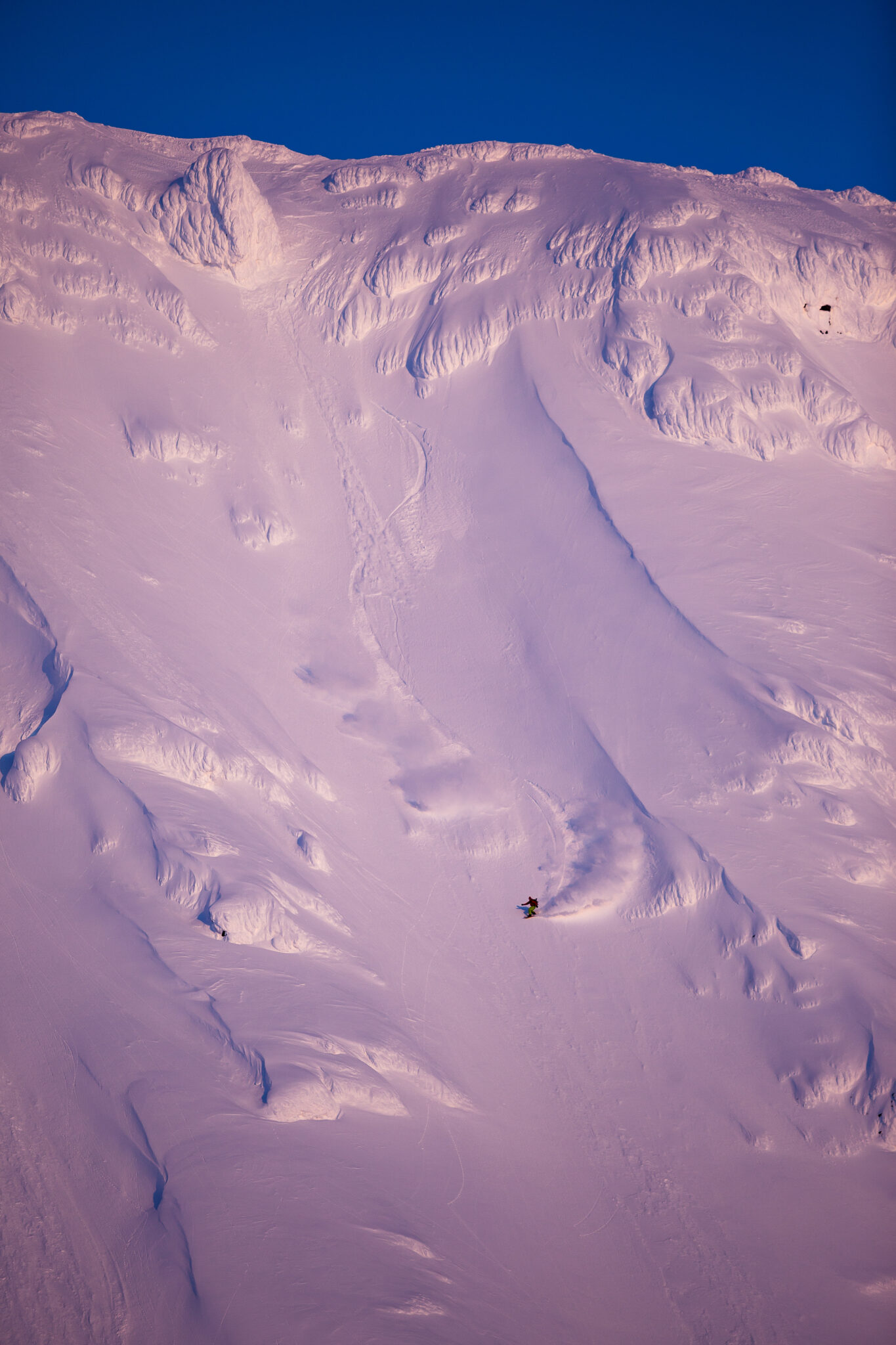
The winters are long, and the season can be roughly divided in four parts. Early-, mid-, high- and late season. Although skiing is possible year-round on the higher glaciers, the first snow falls around September and the skiing usually starts in early season in October/November. The early- and mid-winter are somewhat complicated but also very rewarding. There are only a few hours of daylight in the early season so if one wants to ski during daylight, the approach needs to be done in the dark. The snowpack is usually thin and very cold, resulting as instabilities from the avalanche perspective, there’s no warming effect by the sun and the sharks are always around. But when the stars align and one hits a good slope or a couloir with perfect timing, it is possible to ski perfect powder in absolutely stunning early winter light. Low polar sun barely rising over the horizon giving magical orange light and turning everything pink on southwestern aspects, while on the northeastern side everything is deep indigo blue, violet and dark. The contrast between the two aspects in the sky is phenomenal. Top that up with Northern Lights and you have a ski day to remember. It’s also kinda fun to ski down with a good headlamp.
High season is March and April. In the spring days are long up north and it’s a good time for bigger missions. In high season the snow is still cold, powder can be found in all aspects and altitudes and the skiing is generally very good. Later towards the spring, the timing is everything to find good snow and reasonably safe conditions. The warming effect of the sun will be needed to be taken into consideration, and should one choose to ski east facing powder, an early start is mandatory, and south faces start to warm up quickly. The climate is maritime, which means the snow often falls with humidity and sticks well on the slopes as well as on the rocks, resulting in those beautiful rime covered peaks.
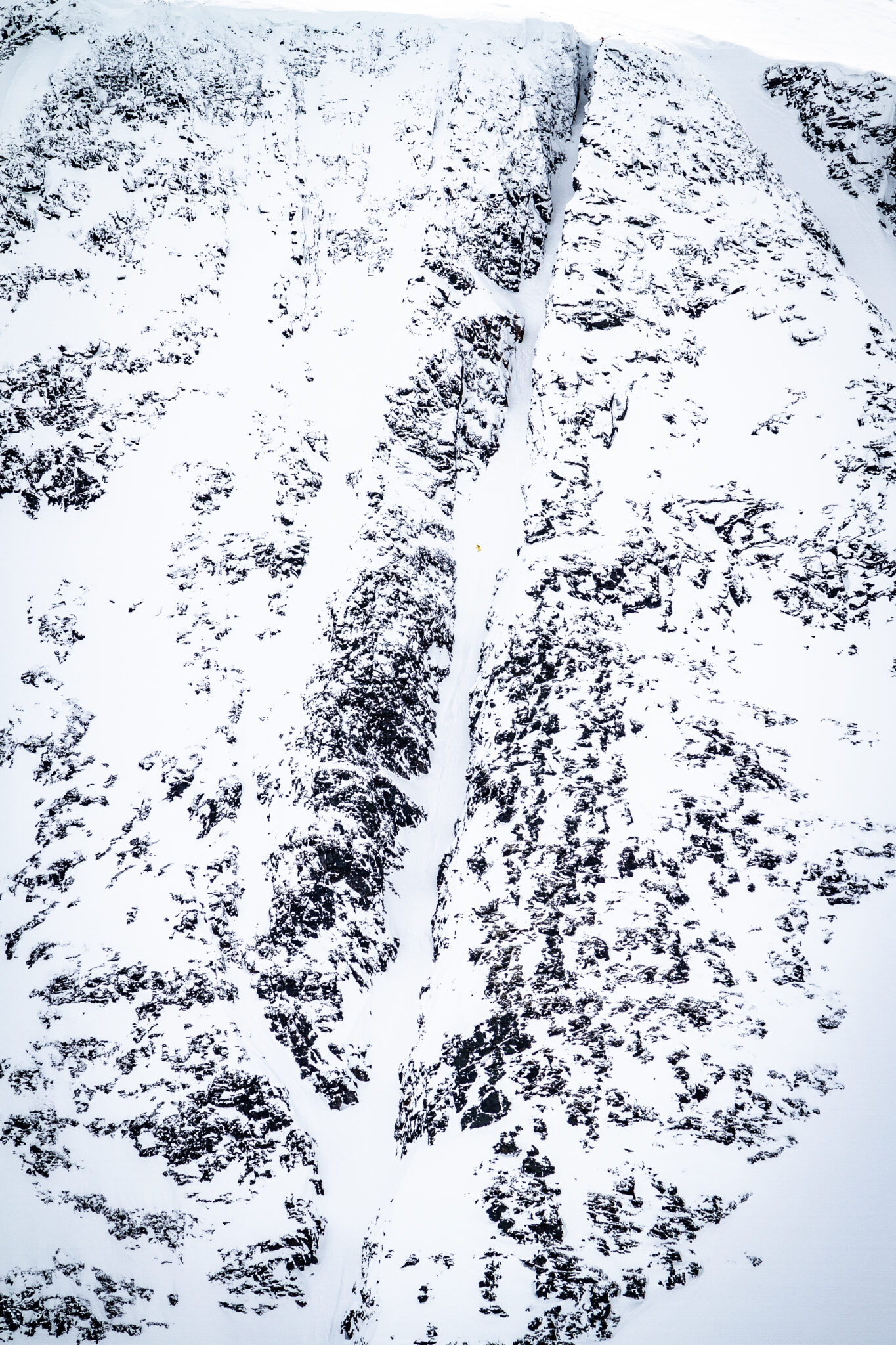
The Polar Day, official nightless night, begins the 20th of May and the sun will not set until the end of July. That means that in late April and early May up in the mountains one can enjoy sunsets or sunrises that last for hours, bringing magical light and long shadows. Well-chosen objectives offer unreal night skiing lit by the setting or rising sun even on the very northern aspects. Later in the season one can play with aspects to find either good corn skiing in the sun or powder in north and east aspects.
“I have lots of good memories from many different days in the mountains in Lyngen with many different friends and it’s impossible to put them in any sort of order. If I would need to come up with top three experiences, they would be the first descent of the Northwest face Store Fornestinden, first descent of the North Face of Store Lakselvtind and first descent on the Northwest face of Nallagaisi.
Store Fornestinden is a really cool summit, 1477 meters and the line is good and steep, 35°-45° for over 1200 meters, including a few hundred meters of steep lower slopes, a big couloir/face for 900 meters, a few meters of rock climbing over a step and the steep final slope before the summit. It was Burns’s idea to go there and they took me along. The guys had been scoping it out a few days earlier, but a storm moved in and they were forced to bail. We got in there right after a two-day storm, on a cold, bluebird day. There was so much snow. We crawled our way up in the powder, sometimes up to our chest. It was completely insane, too soon for anything to stabilise. I was kinda shaking my head going up knowing that this is not very smart but since there were not any scary signs, the boys were all happy to go and nothing catastrophic was happening around us, so we kept going. We got up to the rock step high up the face and find out that the wind had formed a perfect balcony below the rocks on which to chill a bit in safety. We climbed through the step and found the upper slope being windswept, hard snow. I didn’t have crampons or ice axe because I thought if I needed them the snow would be too bad to snowboard down anyway. I didn’t want to bail so high, so I ended up cutting steps with my snowshoes, which was quite taxing on a hard packed 45° slope. At the top we quickly transitioned, had a smoke, and started going down. The first part was crispy but not too bad, grippy snow just not much of fresh. On the skier’s right side of the top slope there is a massive vertical wall which led to the rock step and continued below it. We stopped above the rocks and the balcony and started thinking how to get through it with boards on our feet. I don’t know where the idea came from but suddenly, I felt like jumping over the rock step and the balcony into this perfect powder halfpipe sort of transition. The only problem was the rock wall on the right continuing next to the landing and a super firm, 45° take off. After a few moments of hesitation and risk evaluation, I went for it. Two seconds after pointing it I felt like I’m going faster than anyone has ever gone, got in the air, gapped the whole thing and had the smoothest and softest landing ever on the powder tranny, tons of speed, the wall flying past me at arm’s length and the snow was just perfect. I knew I should be slowing down but everything felt too good to hit the brakes, so I just kept pointing it down. I still remember that feeling. At some point the speed was getting ridiculous and I started braking, hit something hard and crashed. There was so much snow that even though I was going quite fast, I just kinda buried myself in the powder. I was a bit bummed to fall but then again, the feeling had been too good to slow down, and I knew that there would be still 1000 meters of bottomless fresh snow. The rest of the run was an absolute bliss, probably the best one I ever had, and I rode it nonstop to the bottom and I don’t think I have ever ridden snow as good. Thanks Nick Burns, Janne Järvinen and Teemu Myllynen for a memorable ride.
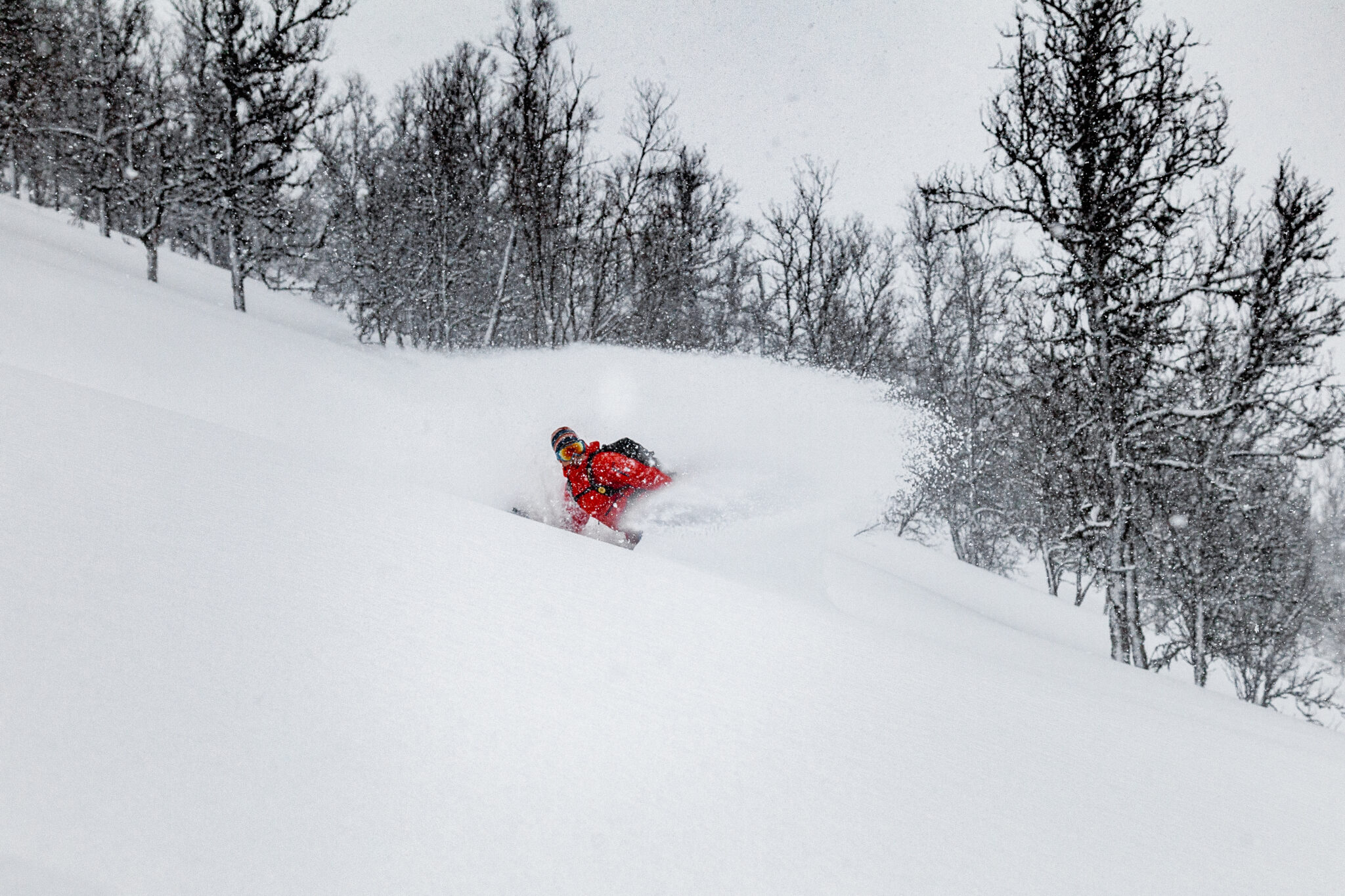
Store Lakselvtind is the highest summit on the Lakselvtindan massif, 1616 meters and a famous climbing objective. There are a few ski lines that start close to the summit, but no one had yet skied from the actual rocky, pointy summit. I had scoped a line towards the north. It starts with a very exposed and narrow ridge, drops into a sort of a ramp that leads into a couloir and down to the glacier. The technical part is not very long, only about 400 meters but the summit is spectacular, and the line is pretty cool also. It was late in April and the sun was strong even on the northeastern aspects, so an early start was required. With my friend and a video wizard Lauri Aapro, we started from the valley around 4 in the morning to be at the top early enough. The plan was to go up the South Col below the summit pyramid, where Lauri would stop and wait and film with a drone while I climbed a couloir and a rock ridge to the summit and ride down the north side. The climb was nice, steep and firm snow, a small ice fall and an easy but exposed rock ridge. The summit is perfectly flat, maybe 8×8 metres and really airy. The only way to go is this narrow, maybe 2 meters wide and super exposed ridge towards the north. I downclimbed the ridge for a few meters to see if there’s anything suspicious but the snow felt good. I went back to the top and strapped my board on. It was such a cool feeling to start down a new line from the highest summit of my favourite mountain. The ridge was exciting but felt safe and as soon as I got on the ramp, even though it was above some cliffs, I was breathing easily and enjoying the ride through the ramp, into the couloir and down the glacier. The glacier took me to the far side of the massif close to the middle of the peninsula and almost to the foot of the prettiest mountain in Lyngen, Nallangaisi. I thought that since I’m already here, I might as well go take a look at a line that I have been waiting to be in condition for a few years. After about an hour approach, I got to the bottom of the Northwest Face of Nallagaisi. I started up the line but quickly realised that the snow was not good enough to meet the standards and that my legs were already quite shot after an intense morning so I hopped on over the ridge to the west face and bailed back to the road and started waiting for a new snowstorm that would put the line back into condition. A long day but one I won’t be forgetting anytime soon. Oh yeah, Lauri. He filmed the whole thing with his drone, great footage, and after packing up his camera gear, he flew down and around the mountain with his speed flying wing. Talk about silent heroes, he dragged up his ski gear, climbing gear, cameras and the speedflying wing. Even though I did a cool new line, I think his efforts were way more impressive.
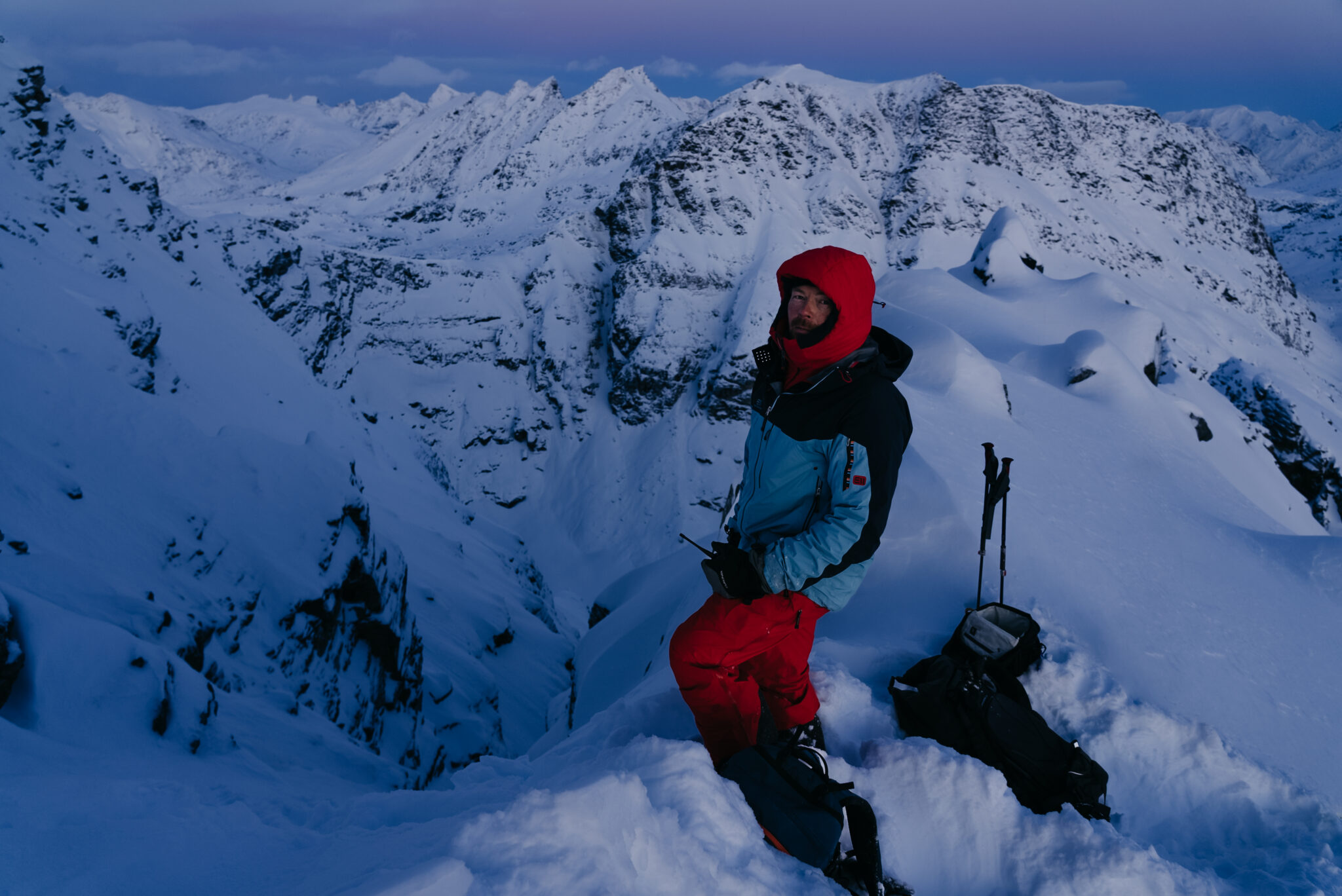
Nallangaisi, 1595 meters, has been on my list since day one. It’s situated in the middle of the peninsula and only the summit and the top slopes can be seen from the road, but it forms an impressive pyramid towering over the ridge in front. I had scoped out a line on the northwest face and gave it a try a week earlier but the snow was not ideal. A few days of rain in the valley and snow up high and I knew it was time to give it a go. The weather cleared and I teamed up with Paul Siljama, a long-time good skiing buddy with who we have had some good times over the years. The approach is quite long so we took an early start to not get too toasted on the sunny western slopes high up the mountain. We started up the couloir and quickly found out that there was perfect, knee deep and consistent powder on the northern aspect, everything felt good and stable, and we were making good progress. About two thirds up the line moves on to an open face on westerly aspect and even though there was some sun from the side, the snow remained the same, good powder. At our high point on the top of a ridge we took a little breather before riding and skiing down. And like I usually do if the conditions allow, I prefer to climb the line to get an idea of the snow and ride the line nonstop from top to bottom with good speed, which we did. Four hours up and 1 minute down. Totally worth it. There was nothing really extreme, just a good consistent line of 1000 meters of great snow in 35°-45° terrain, perfect timing with sunshine from the side aspect that made the snow crystals sparkle, not a single track in sight except our own bootpack which we followed like a zipper of footprints down the mountain. It is difficult to describe the feeling of spotting an unridden line on a remote mountain and waiting for a long time, sometimes years, for it to be in a perfect condition and then finally getting to ski it with good style. Usually, it is worth the wait and for sure this time it definitely fulfilled all the expectations.